
Wealth Centered in Uniontown a Century Ago Continues to Bring Visitors to Main St Today
published on August 13, 2026
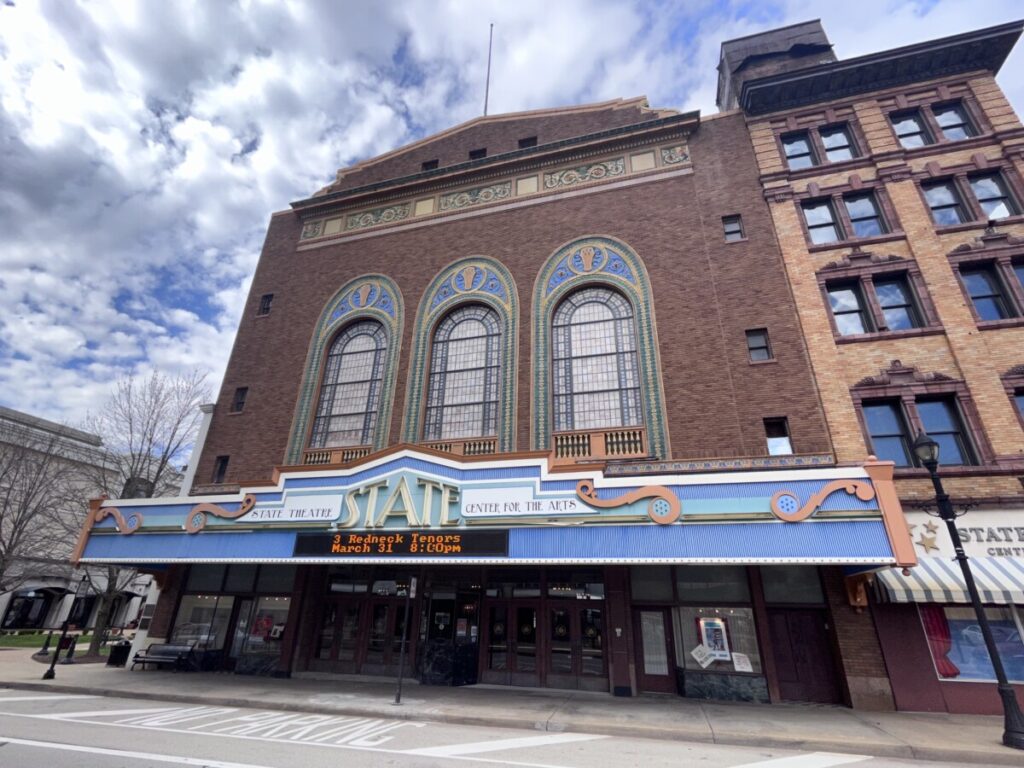
Thomas W. Lamb’s Masterpiece in Fayette County: Designing Uniontown’s State Theatre
When architect Thomas W. Lamb accepted the commission to design the State Theatre in Uniontown, Pennsylvania, he was already one of the most celebrated theater architects in America. His portfolio included some of the nation’s grandest movie palaces in New York, Boston, San Francisco, Toronto, and Baltimore. Yet in 1921, Lamb turned his attention to a thriving southwestern Pennsylvania city whose booming economy demanded architecture that reflected its growing prominence.
The resulting State Theatre, opened on October 30, 1922, and was far more than a place to watch silent films. It was a carefully orchestrated architectural experience that transformed an evening into an event.
A Prosperous City Commissions the Arts
To understand why Uniontown commissioned one of America’s leading theater architects, it is important to understand the city’s remarkable prosperity during the early twentieth century.
By the 1910s and 1920s, Uniontown was flourishing as the commercial center of the Connellsville Coke Region, one of the world’s greatest producers of metallurgical coke. The surrounding beehive coke ovens fueled the nation’s expanding steel industry, while nearby coal mines generated enormous wealth for industrialists, merchants, and local businesses. Banks, department stores, hotels, office buildings, and civic institutions transformed downtown into one of southwestern Pennsylvania’s busiest commercial districts.
By 1912, Uniontown had thirteen theaters, evidence of a population with both disposable income and an appetite for recreation. Yet local investors envisioned something even grander—a true movie palace that would rival those found in larger cities.
The city’s optimism was reflected in its construction boom. Local newspapers reported that the new State Theatre, combined with neighboring commercial development, represented approximately $1.6 million in new construction concentrated within a single section of downtown. The Evening Standard newspaper proudly observed in April 1922 that “no other section of the city can show a tenth as much new capital invested in the same time.”
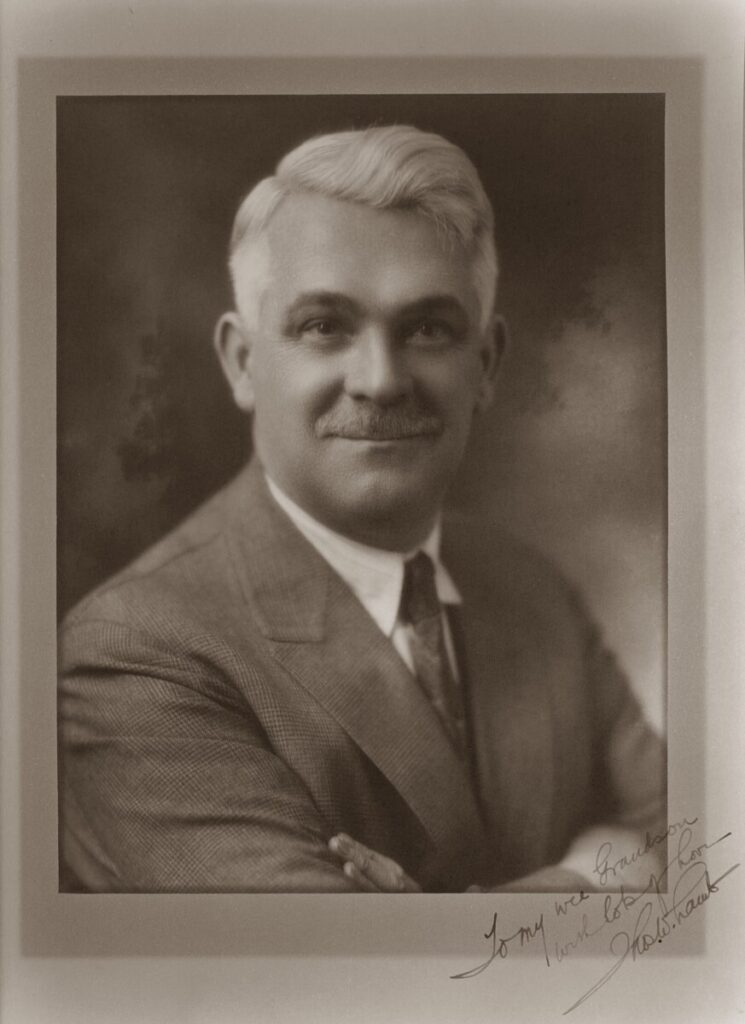
Thomas W. Lamb: America’s Theater Architect
Thomas W. Lamb was selected to design the State Theatre because few architects better understood the emerging world of motion-picture entertainment.
Born in Dundee, Scotland, in 1870, Lamb immigrated to the United States as a child and studied architecture at Cooper Union in New York City. By the 1910s he had become one of the country’s foremost theater architects, designing hundreds of theaters for major chains including Fox, Loew’s, and Keith-Albee.
Among Lamb’s most influential works were New York City’s Mark Strand Theatre (1914), widely regarded as America’s first great movie palace; the Rialto Theatre (1916) and Rivoli Theatre (1917) in Times Square, which established the standard for luxury cinema architecture; the Capitol Theatre in New York (1919); the Fox Theatre in San Francisco (1929); Boston’s B.F. Keith Memorial Theatre (today’s Boston Opera House); Baltimore’s Hippodrome Theatre; Columbus’s Ohio Theatre; and Toronto’s Pantages Theatre (now the Ed Mirvish Theatre). Many of these buildings remain among North America’s finest historic theaters.
Lamb’s genius extended beyond decorative architecture. He carefully planned audience circulation, sightlines, acoustics, stage facilities, and patron comfort, creating buildings that functioned as efficiently as they dazzled visually.
Construction of the State Theatre
Construction began in 1921 on the site formerly occupied by the Lyric Theatre and the Morning Herald building. By the time the building neared completion, newspapers estimated its cost between $600,000 and $750,000, making it one of the largest private construction projects in Uniontown’s history. One article proudly noted that the structure contained more than one million bricks, weighed over nine million pounds, and was built so solidly that it “should last 200 years.” Remarkably, the newspaper also observed that the State Theatre represented Lamb’s 1,726th architectural commission, and that he had designed 72 theaters during 1922 alone, illustrating the extraordinary demand for his expertise.
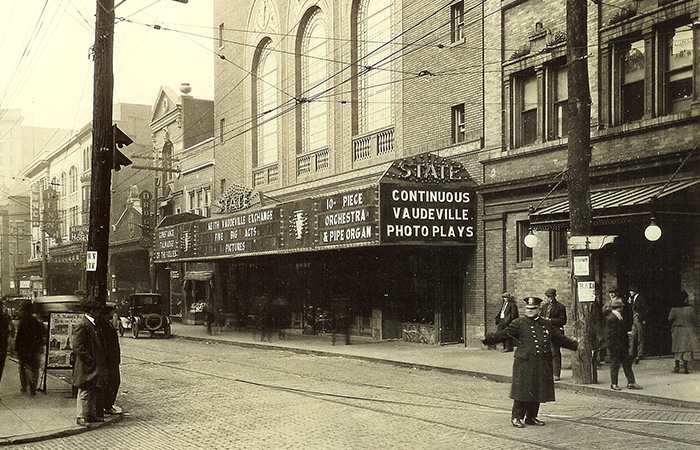
An Exterior Designed to Impress
Designed in the Neo-Classical Revival style, the five-story façade features dramatic three-story arched windows that emphasized verticality and elegance. Rather than simply housing entertainment, the building projected permanence and civic pride.
Even before patrons entered the lobby, they encountered another engineering marvel—a massive electric marquee. Contemporary newspapers claimed it was the largest theater sign yet constructed in America. Manufactured by Chicago’s Lu-Mi-Nus Sign Company, the illuminated sign arrived in nine crates and featured hundreds of colored electric lights. A duplicate was later ordered for Chicago’s McVickers Theatre, demonstrating that Uniontown briefly possessed the country’s most technologically advanced theater sign.
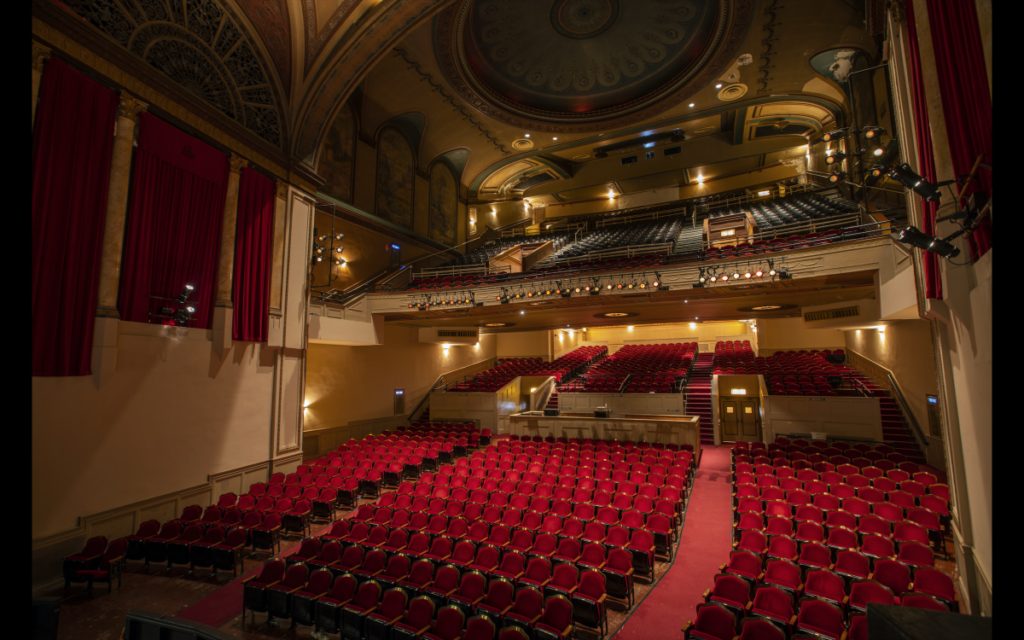
Interior Elegance
While many movie palaces overwhelmed visitors with lavish ornamentation, Lamb favored a more restrained sophistication for Uniontown.
The theater’s interior employed the Robert Adam style, an eighteenth-century neoclassical design language known for graceful proportions, delicate ornamentation, and harmonious balance. Contemporary descriptions emphasized its “refinement of line and chasteness of ornamentation,” creating an atmosphere of timeless elegance rather than theatrical excess.
The interior was executed by the Ingstrup-Burke Company of Chicago under artist Michael Tomin, who had studied at the Imperial School of Fine Arts in St. Petersburg, Russia before continuing his artistic education in Chicago. After viewing the completed work, Tomin reportedly declared:
“It is better than I hoped. It is what I dreamed.”
Designed for Incredible Acoustics & Performance
The auditorium accommodated approximately 1,650 patrons, while careful planning ensured excellent sightlines from every level. Lamb’s reputation for acoustical excellence proved especially valuable during the silent-film era.
The theater featured a $40,000 Peloubet Master Organ, complete with a specially constructed echo chamber that enriched its sound throughout the auditorium. Combined with the resident symphony orchestra, the organ transformed silent films into immersive theatrical experiences.
Behind the scenes, Lamb incorporated professional stage facilities including a double wooden stage floor with maple at the front for dancers, eight dressing rooms for principal performers, additional chorus facilities, and sophisticated stage rigging and lighting. These practical features ensured the theater could host first-class vaudeville productions as well as motion pictures.
A Century of Vaudeville, to Talking Pictures, to Community Preservation
The State Theatre opened with an ambitious program featuring Keith vaudeville performers, Norma Talmadge’s The Eternal Flame, comedy shorts, newsreels, a live orchestra, and performances on the new Peloubet organ. It later adapted successfully to talking-pictures before becoming the State Music Hall, hosting performers including Johnny Cash, Waylon Jennings, Slim Whitman, and the Statler Brothers. Community preservation efforts rescued the building in 1988, allowing it to continue serving as a performing arts center and educational venue today.
More than a century after its opening, the State Theatre stands as a reminder of both Thomas W. Lamb’s extraordinary talent and Uniontown’s remarkable period of prosperity. At a time when Fayette County helped power America’s industrial economy, local leaders chose an architect whose work graced Broadway, Times Square, Boston, San Francisco, and Toronto. The resulting building demonstrated that Uniontown considered itself worthy of the very best—and Thomas W. Lamb delivered a theater whose elegance and craftsmanship continue to inspire audiences today.